Bronze Halo Letters in Europe: Finish, CE Compliance and Mounting
A European halo-letter order gets judged on things a US order never asks about: a signed Declaration of Conformity, an IP rating that survives a jet wash, a bronze that is still bronze after three winters, and a full-size template that lines up with 40 mm battens. These are the decisions that decide whether the sign clears customs and looks right a year later.
Most of the enquiries we get from Europe are not really about price. They arrive as a specification list — letter height, finish, standoffs, driver voltage, an IP rating, a delivery postcode — and every line on that list is a place where a Chinese factory and a European buyer can misunderstand each other.
This page goes through that list in the order a project actually reaches a decision. It also says plainly where we can help and where we cannot.
1. What “bronze” actually means on a sign
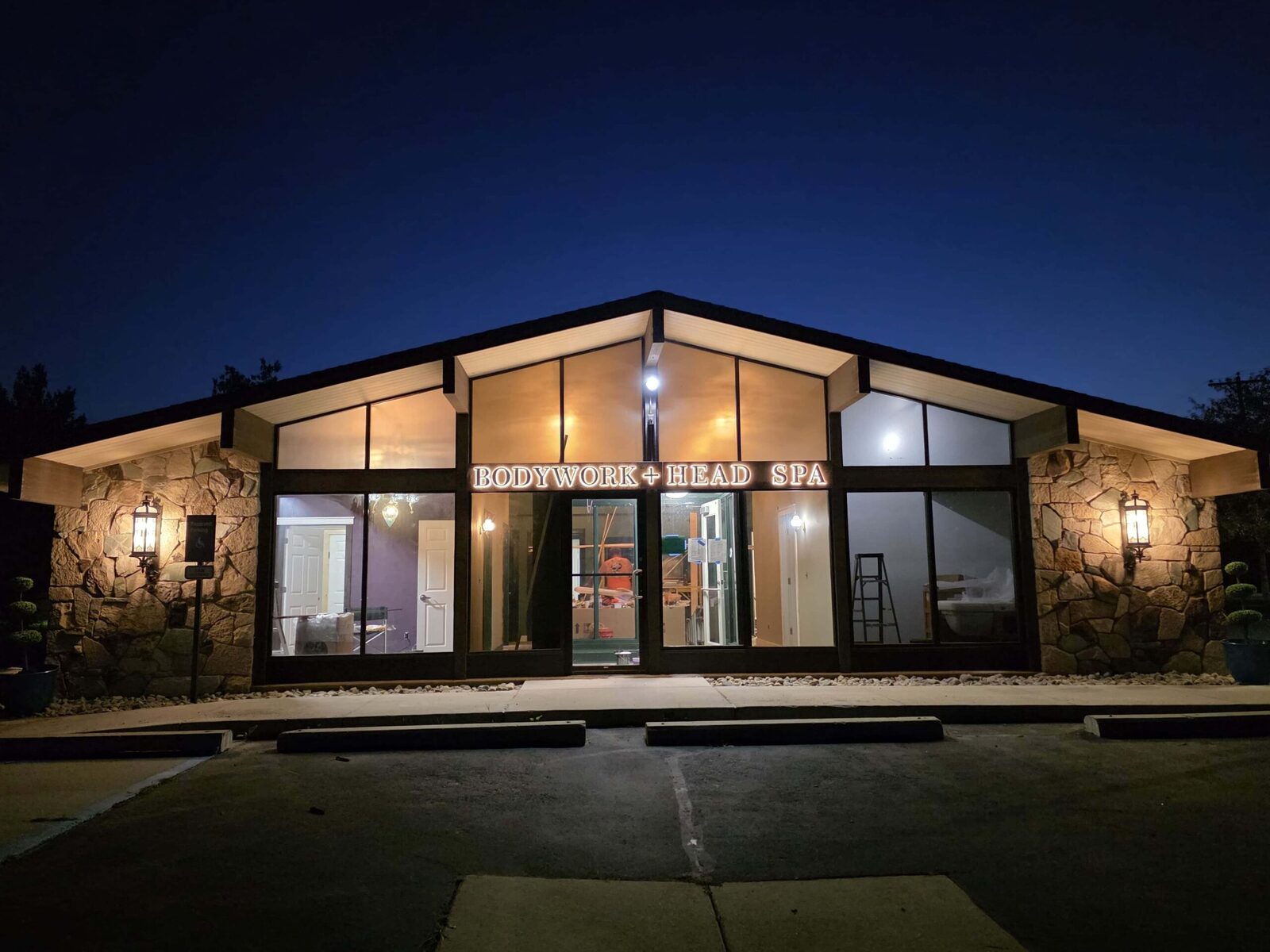
“Bronze matt finish, lacquered, bronze texture” is a common line in a European spec, and it can describe four quite different products. Knowing which one is being quoted changes both the look and the price.
Painted aluminium. A bronze base coat with a matt clear coat over it. This is the workhorse option: consistent colour, repairable, and the “texture” in the spec is produced by the paint system rather than by metal. Most bronze letters on European shopfronts are this.
Powder coat. A thicker, harder film with a slightly different sheen. Fewer colour options in true bronze tones, and touch-up is harder because the finish is baked on.
Anodised aluminium. The colour is in the metal skin, not on top of it. It does not chip the way paint does. The bronze range is limited and tends to read more metallic and less warm.
Real bronze or brass sheet. Actual metal, either solid or clad over an aluminium body. Looks the most like aged metal and costs noticeably more. It is a different fabrication job, with different cutting, different fixing and different weight.
2. Why the finish changes the lighting, not just the look
Halo lighting works by throwing light at the wall behind the letter. A pale wall bounces most of it back. A dark, matte surface — and bronze is a dark, matte surface — returns noticeably less.
That matters because buyers usually choose the finish and the LED count at different times, often from different people. The same module count that washes a white-painted aluminium letter cleanly will make a bronze version look like a thin outline, and the owner will blame the LEDs.
The two decisions have to be made together, which is why we draw the lighting before we quote the paint. Warm white is the usual choice for bronze, because a cool white LED turns a warm metal grey. If you are comparing specifications, see which LED modules we use and how brightness is specified.
3. What salt reaches first
For a shopfront in Nice, Marseille or Lisbon, the coastal question is not whether the finish will fade. It is which part fails first. In practice it is almost always the fixing hardware, not the letter face: the standoff, the screw, the drilled hole, and the edge where the paint film ends.
Two decisions cover most of it. First, specify the standoffs and screws in 316 stainless rather than 304 — the molybdenum content is what resists chloride pitting, and the price difference on a sign this size is small. Second, seal every penetration, and expect to inspect the hardware annually rather than never.
Any coating, ours included, is a maintenance item on a coastal façade. A supplier who tells you otherwise is selling you a future argument.
4. Colour approval: a swatch, not a screenshot
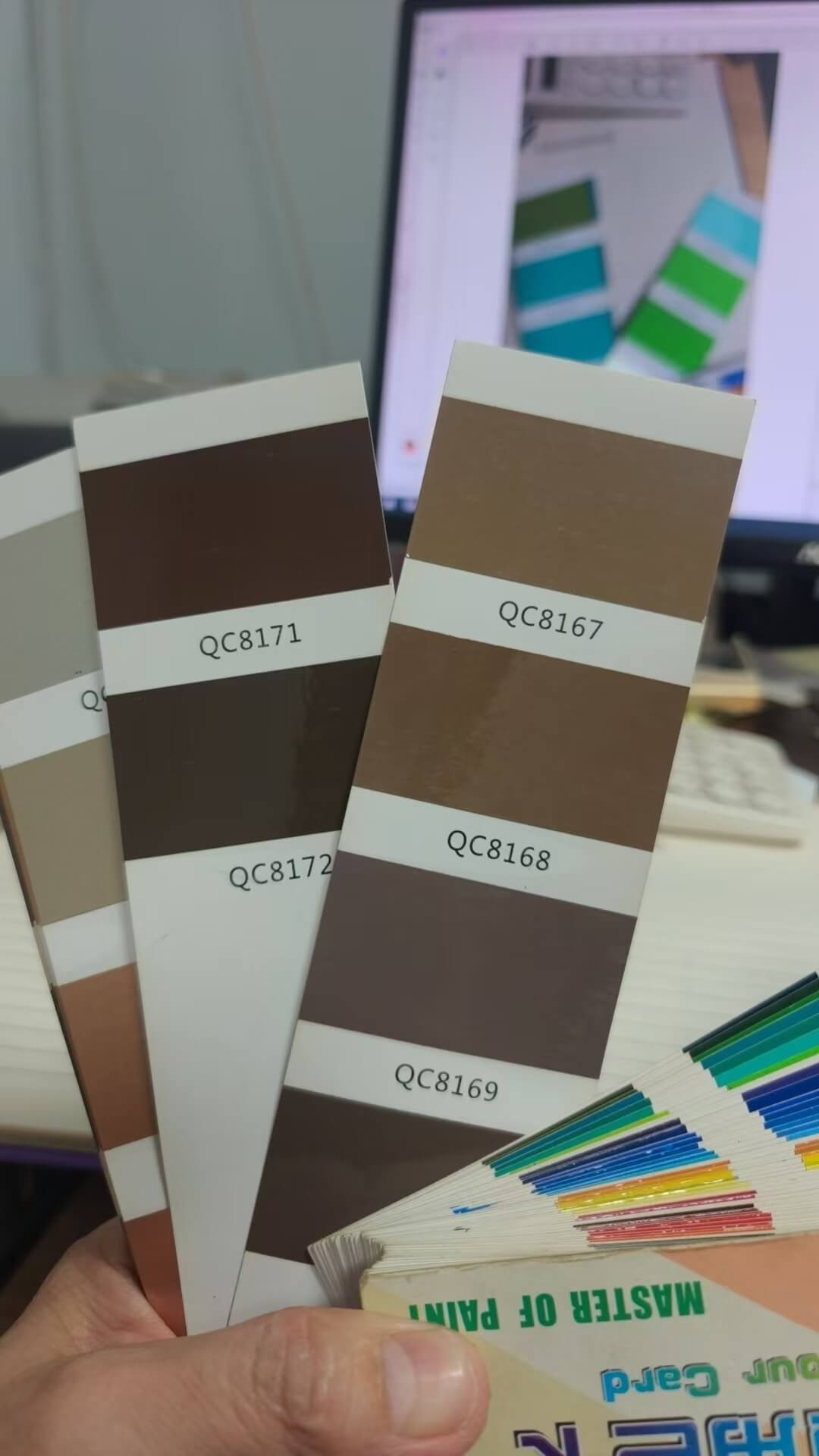
Bronze is the hardest family of colours to approve remotely. It shifts with the screen, with the angle of view, and with the colour temperature of whatever light is hitting it. Two bronze letters that look identical on a monitor can be visibly different on the same wall.
The process that avoids this is short: agree a colour target, receive a physical swatch, sign it off, and keep that swatch as the master reference for the order. Paint batches vary slightly, and the approved swatch is what settles any question later.
For a multi-part sign — letters plus a flat subline panel, for example — all parts have to be sprayed from the same batch. Otherwise the subline reads as a different bronze in daylight, which is exactly the detail a customer notices and cannot unsee.
5. CE is not a certificate
This is the part of a European order that causes the most confusion, so it is worth being blunt: CE marking is a declaration by the manufacturer, not a certificate issued by an authority. There is no central body that “certifies” a sign.
What the manufacturer signs is a Declaration of Conformity (DoC). It names the directives the product meets and the standards used to demonstrate it. For an illuminated sign the relevant ones are normally:
- Low Voltage Directive 2014/35/EU — the 230 V side of the installation
- EMC Directive 2014/30/EU — emissions and immunity of the driver
- RoHS 2011/65/EU — restricted substances in the electrical parts
The standards you should expect to see named on the DoC are the luminaire standard EN 60598 for the assembly, EN 61347 for the driver, and EN 62031 for the LED modules, with EN 62471 for photobiological safety where laser-like glare is a concern.
What to actually ask for, from us or anyone else:
- The signed DoC, with the directives and standards listed on it — not a logo on a PDF
- Test reports with a report number and the name of the laboratory that issued them
- Confirmation that the report covers the complete luminaire, not only the LED module on its own
- A stated input voltage on the report that matches what is being shipped — a 120 V report does not cover a 230 V order
Rather than describe our paperwork, we publish it. These are the component documents we hold, downloadable without an enquiry:
- UL Recognized Component Certificate (E334687)
- UL Mark Safety Scheme Certificate (24V LED module)
- CE certificate, injection-moulded LED module
- CE EMC test report (EN 55015 & EN 61547)
Read the scope line on each one. They are supplier certificates for the named module or model, not a certification of the finished sign — the same caveat applies to every factory publishing this kind of file, ours included. A Declaration of Conformity for the complete luminaire is a separate document signed by the assembler, so if your project or your landlord requires one, raise it before quotation rather than after the crate is on the water.
The same four files sit on our LED brightness and components page, along with what each document does and does not cover.
6. IP65: where the water actually gets in
IP65 means dust-tight and protected against water jets. It is not the same as IP67, which means temporary immersion, and a supplier quoting one when you asked for the other is worth a second email.
The rating applies to the luminaire. In a channel letter the weak points are rarely the module itself:
The driver compartment. The driver is the largest heat source and usually the least sealed part of the assembly. It needs its own enclosure inside the return, not a cable tie to the back panel.
The cable gland. An unsealed gland turns the letter into a container that fills slowly through capillary action and empties onto the modules.
The standoff penetration. Every hole drilled through the back of the letter is a potential water path into the wall cavity and back out through the paint film.
Condensation. Temperature cycling pulls moisture in through the smallest gap and deposits it on the coldest surface. That surface is usually the aluminium face. A drain or vent detail solves this better than more silicone.
7. 230 V and the European power question
European sign installations are 230 V / 50 Hz, usually hardwired rather than plugged. The driver has to be matched to that. There are two common arrangements: an internal driver inside the letter return, which keeps the façade clean but puts heat and the service point inside the sign, or an external driver in a remote enclosure, which is easier to maintain and easier to replace.
Wide-range drivers rated 110–240 V simplify a supplier's stock and are common, but the CE report has to cover the actual driver model being shipped, not a similar one. If a quotation lists a driver part number, that number should appear on the test report.
Metal letters also need a proper earth connection. The earthing point should be marked on the drawing so the installing electrician can find it.
8. Mounting halo letters on a wood façade
A timber façade — the common European detail of 40 × 40 mm battens over 27 mm multilayer panels — is a perfectly good substrate, provided the standoffs land on the framing rather than on the panel alone. Panel alone will hold a letter for a season and then start to move.
The practical sequence is: confirm where the battens run, place the standoff holes on those lines, and drill through the cladding into framing with a backing plate behind. Every penetration gets sealed, and the sealant is finished so water runs off rather than pooling.
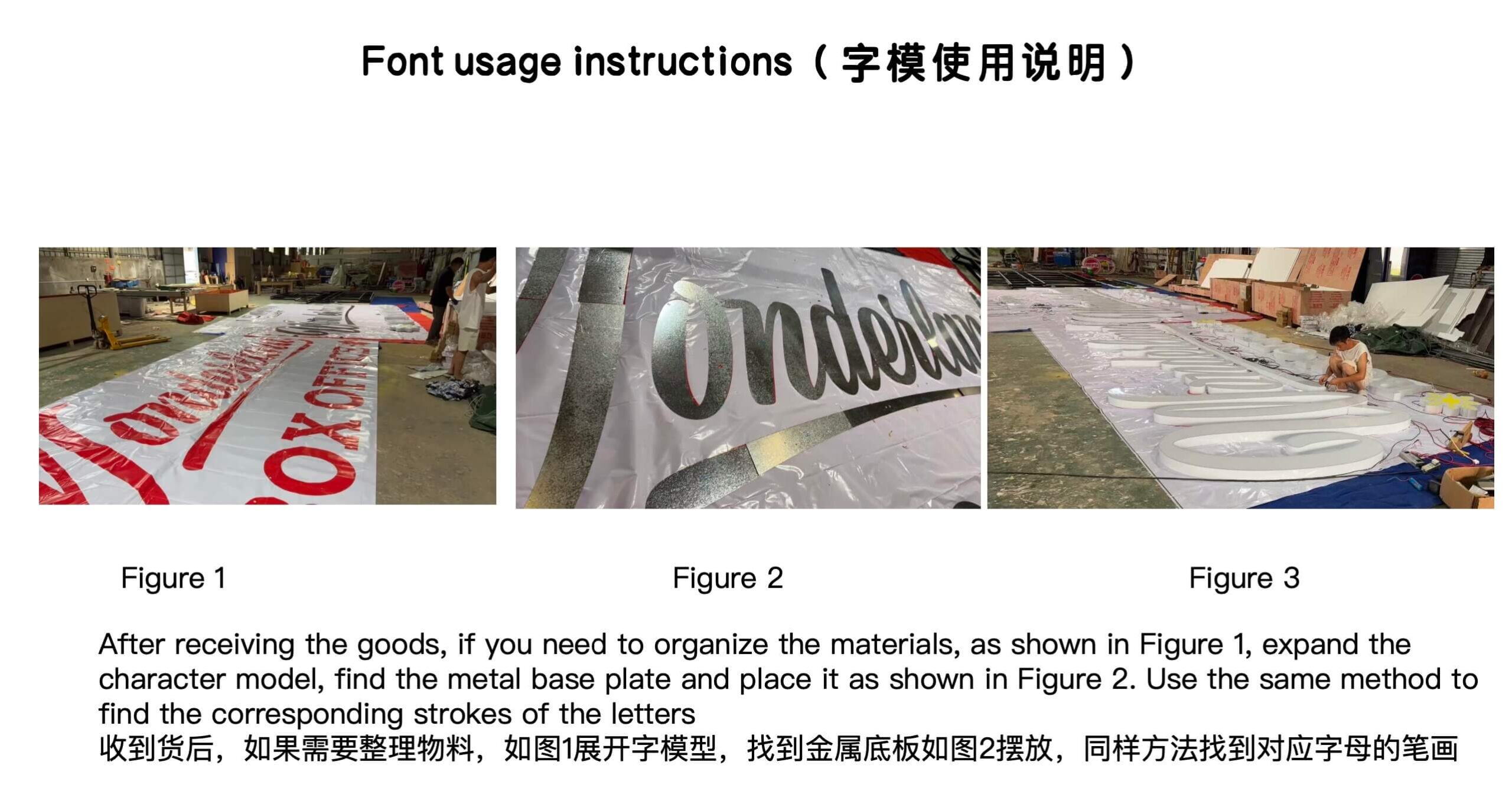
This is what the full-size template is for. It is printed at 1:1, taped to the façade, and used to drill through — so the template has to carry the letter outlines, the hole centres, the electrical feed point and the transformer position, all on one sheet. A dimensioned drawing is not a substitute. Nothing on a building site is measured twice if it can be measured once.
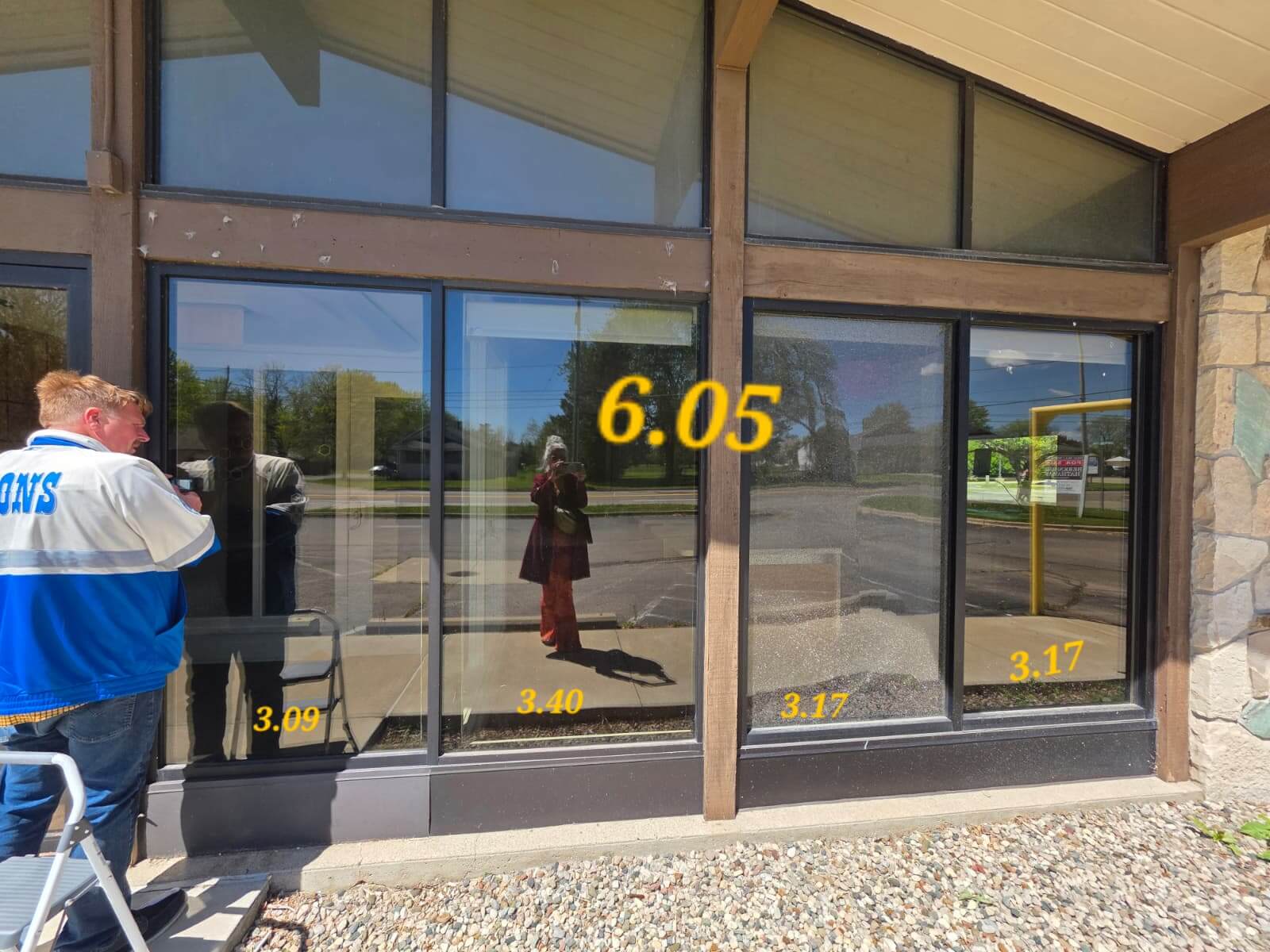
Before the template is drawn, someone has to measure the building. On a real site that means tape marks on glass and a phone photo, not a CAD file.
For the general case, including masonry and metal substrates, see how commercial signs are mounted to the wall.
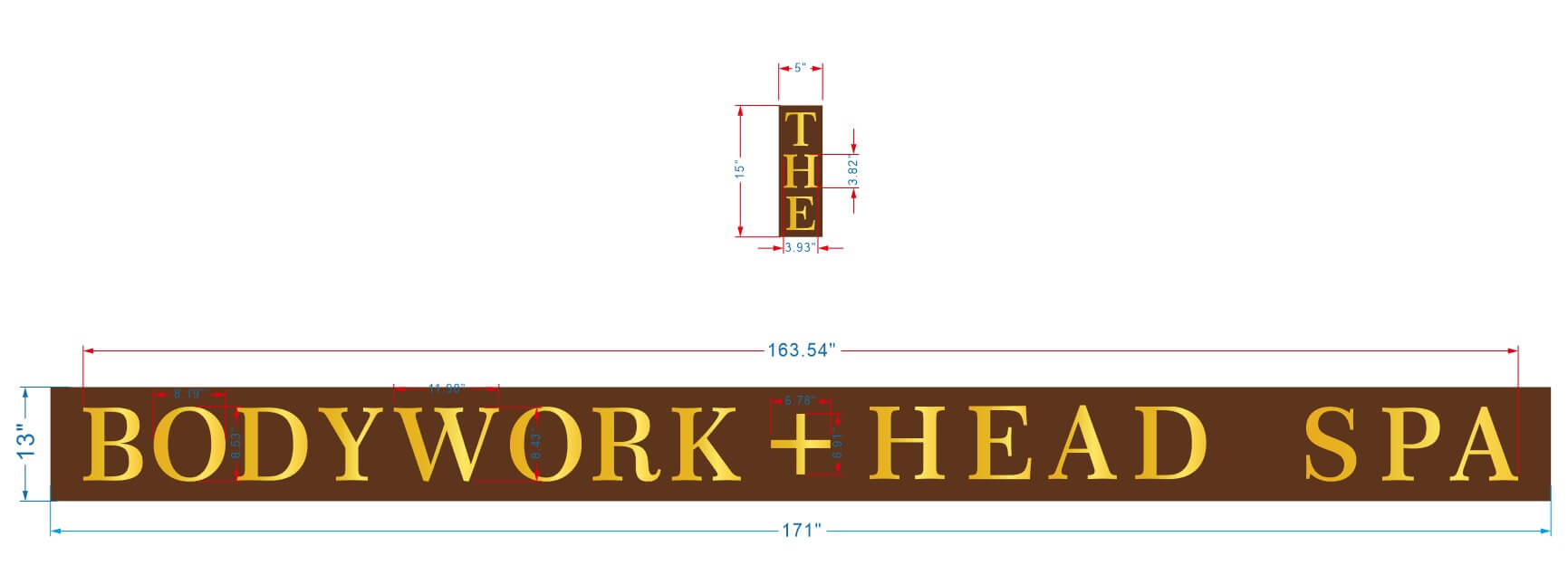
9. What a European quotation has to contain
A quotation that only states a total price cannot be compared with another quotation. It also cannot be checked when the sign arrives. The line items a European buyer should insist on:
- Price broken down by illuminated letters, LED and driver, non-illuminated subline lettering, and any façade elements quoted separately
- Finish confirmation, with a physical swatch rather than an image
- Confirmation that a 1:1 template and all fixing hardware are included
- Production lead time, counted from artwork approval rather than from order date
- Crate type, dimensions and weight — needed before the sign is shipped, not after
- Price terms: EXW, FOB and DDP as separate lines, so the landed cost is visible
- Warranty terms split by component: letters, LED modules, driver
- CE DoC and RoHS documents for the electrical parts
- Payment terms and the deposit percentage
- Photographs of comparable projects, which is what most buyers scroll to first
DDP is usually the line that decides the order. Under DDP the freight, customs clearance, duty and VAT are inside the quoted price and the buyer receives the crate at the door. That is why we quote it per project rather than per kilo: the duty rate follows the commodity code, the freight follows the volume, and the crate dimensions are not known until the artwork is fixed. See how DDP freight is priced and how long a custom sign takes.
10. What we do not supply, and one thing we have not done yet
Two honest limits, because they come up in every European enquiry.
The timber façade is not our part. Battens, multilayer panels and the finished RAL-painted cladding should be sourced locally — it is cheaper, it arrives faster, and the joiner who fits it owns the weatherproofing detail. We supply the letters, the hardware and the template that tells the joiner where to drill.
Our installations to date are in the United States. We have not yet delivered a project inside the EU. That is worth saying plainly rather than implying references we do not have. What we can document is the electrical paperwork, the finish process, the template and the crating — all of which are the same work regardless of destination — and the first European project will be documented here as it happens.
If your project needs references inside the EU specifically, ask us. We will tell you honestly whether we have them for your product type.
Frequently asked questions
Can you supply CE documentation for the LED modules and driver?
The component documents are published on our site and can be downloaded without asking: a UL Recognized Component certificate, a UL Mark Safety Scheme certificate for the 24 V LED module, a CE certificate for the injection-moulded LED module, and a CE EMC test report to EN 55015 and EN 61547. They cover the listed component rather than the finished sign; a Declaration of Conformity for the complete luminaire is a separate document, so if your project needs one, say so before quotation.
Is the bronze finish paint, anodising, or real bronze?
It can be any of the three, and the price differs sharply between them. The most common European specification — bronze matt, lacquered, with a texture — is a painted system with a matt clear coat. Real bronze sheet is a different fabrication job. Always agree the route from a physical swatch rather than a screen image.
Do halo-lit letters work on a wood façade?
Yes, as long as the standoffs land on the timber framing rather than on the panel alone, every penetration is sealed, and a full-size template is used so the holes are drilled once and in the right place. The timber cladding itself is normally best sourced locally.
What IP rating do outdoor channel letters need?
IP65 is the usual specification for an outdoor sign: dust-tight and protected against water jets. IP67 adds protection against temporary immersion and is worth asking for on washdown or exposed coastal elevations. The rating covers the luminaire, not just the modules. Pay attention to the driver enclosure, the cable gland and the standoff penetrations too.
Do you ship DDP to Europe, and who pays the duty?
Under DDP terms we arrange freight and customs clearance and the quoted price includes duty and VAT, so the crate arrives at your door with nothing further to pay. Duty follows the commodity code and freight follows the crate volume. That is why DDP is quoted per project rather than per kilogram.
If you are still deciding on the construction itself, start with how reverse halo letters work, then the product page for reverse halo signs. For metric drawings, inches to centimetres converts the dimensions we quote; for budget planning, what a sign quote includes lists every line you should see.
- Brushed gold halo-lit letters for a Michigan wellness studio
- Four round halo-lit signs for a New York college
- A halo-lit storefront logo for Betta USA
Send us your specification
Letter height, finish, voltage, installation postcode and a photo of the façade. We reply with a drawing, a lit mockup and a DDP price — usually within 24 hours.
Request a European quote