3D Moulded Letters: How They Are Made, What Drives the Price
A buyer sends a storefront photo and asks us to quote 3D moulded letters.” The image may show a crisp acrylic edge, a curved face, or a deep metal return, but it does not reveal how the sign was produced. That matters because the same phrase is used for three different processes with different tooling, volumes, and costs.
If you already know your sizes and want a price, the 3D moulded and acrylic letters product page has the thickness table and the DDP price band.
1. What "moulded" actually means in the sign trade
In signage, the phrase 3D moulded letters usually describes an appearance rather than one manufacturing method. It can mean letters with thickness, a raised face, rounded edges, or a shadow that separates the copy from the wall. These details are useful visually, but they do not tell a buyer whether the letter was cut, formed over a tool, or produced in a steel mould.
The first process is CNC routing. A solid sheet of cast acrylic, extruded acrylic, aluminium, or another suitable material is cut along the letter outline, then the edge and face are finished as required. This is how our 3D acrylic letters are made. The shape comes from machining sheet material, not from pouring liquid material into a mould.
The second process is vacuum forming. A thermoplastic sheet is heated until soft, pulled over a shaped tool, and cooled so it keeps the formed contour. This can create curved faces or repeated shells, but it requires a forming tool. We do not use vacuum forming for the letters described here.
The third process is injection moulding. Plastic is forced into a steel mould under pressure. It can be highly repeatable, but the mould represents a major investment and normally suits large production runs, often several hundred pieces or more. This is not our process either. For custom names, logos, sizes, or moderate quantities, the economics usually favour routing rather than an injection mould.
The useful question is therefore not simply “Do I want moulded letters?” It is “Which construction creates the appearance I need at my quantity?” A routed letter, a vacuum-formed shell, and an injection-moulded part may look similar from a distance, but they are not interchangeable when the project is quoted.
A clear quotation should name the construction, not only the outward appearance. Ask whether the face is cut from solid sheet, formed over a tool, or produced from a mould. Ask how the edge is finished and how the letter is closed at the back. Those answers explain what is being purchased and make it possible to compare another supplier’s offer on the same basis.
2. How a routed 3D letter is made, step by step
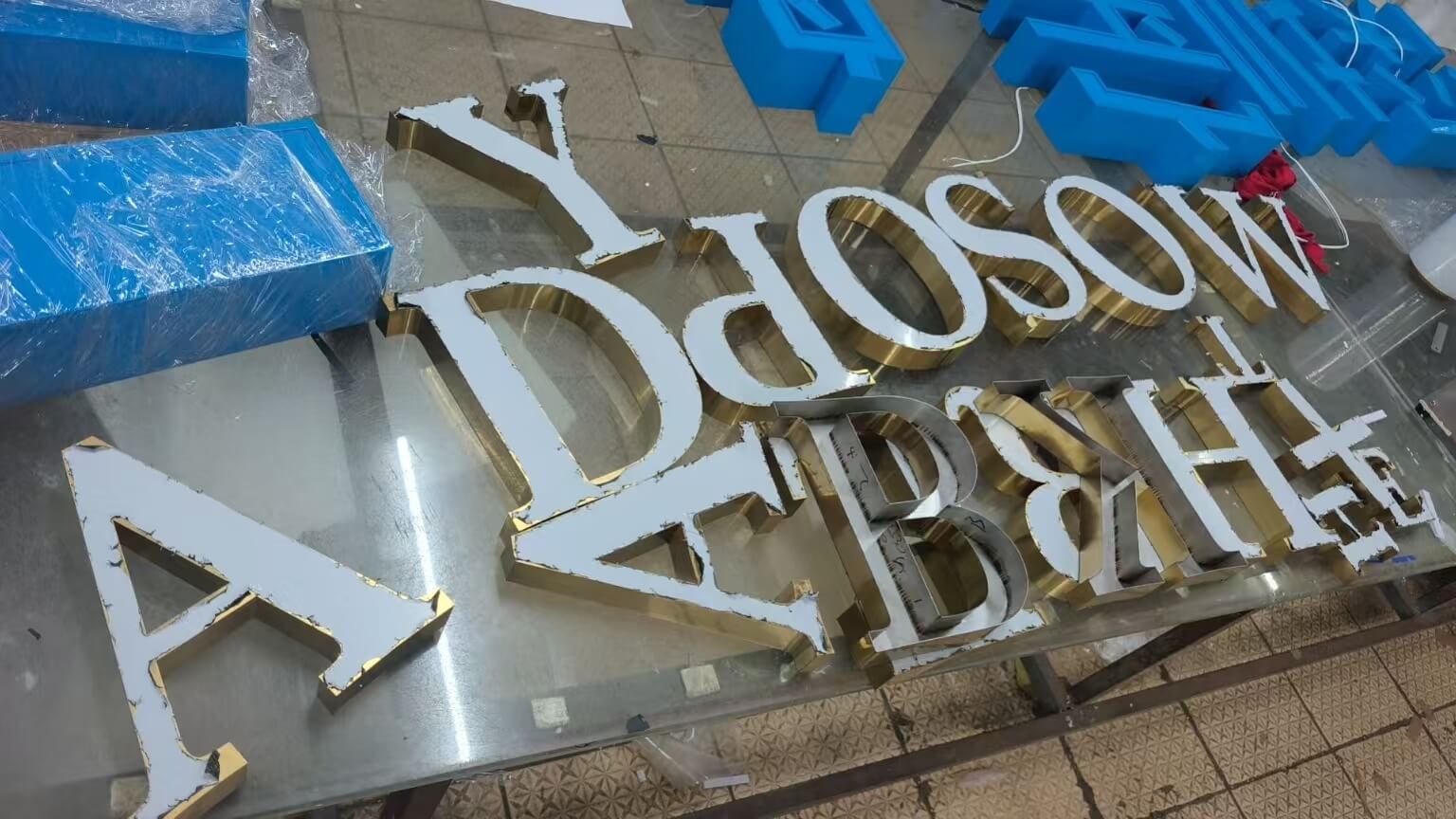
Production of 3D moulded letters begins with artwork that can become a clean cutting path. The outline, counters, stroke widths, and small details must survive at the requested letter height. A thin display drawing may not be strong enough when cut from a solid sheet, so the artwork is reviewed against the finished size before the material is prepared.
The material and finish are then matched to the design. Cast acrylic can be cut and polished as a solid face. Extruded acrylic, brushed stainless, and aluminium are used where their properties suit the construction and appearance. Solid Pantone colour, mirror, brushed, cast crystal, and film-facing finishes each require a different surface treatment. The lighting and wall background should be considered because both affect the final result.
Our Guangzhou workshop uses CNC cutting, polishing, and facing work. Depending on the design, the face, return, backing, and fixing points are prepared and assembled in a controlled order. Threaded studs, keyhole plates, standoffs, and hidden rails require different arrangements behind the letter, so mounting is designed with the front rather than added after it is approved.
A frequent problem is a flat logo drawing with no information about the side profile. The front may look correct while the return depth, fixing position, and wall clearance remain undefined. A useful production drawing shows both the face and the intended thickness so the workshop and installer are working from the same geometry.
The final check covers the set as one sign. Capital height, spacing, alignment, face direction, finish, and fixing positions must agree with the approved drawing. CNC routing avoids a permanent steel mould, but it still involves material, programming, machining, finishing, and assembly. It is a project-specific production method, not a no-tooling shortcut.
3. Thickness in 3D moulded letters: what 6, 10, 15 and 20 mm are for
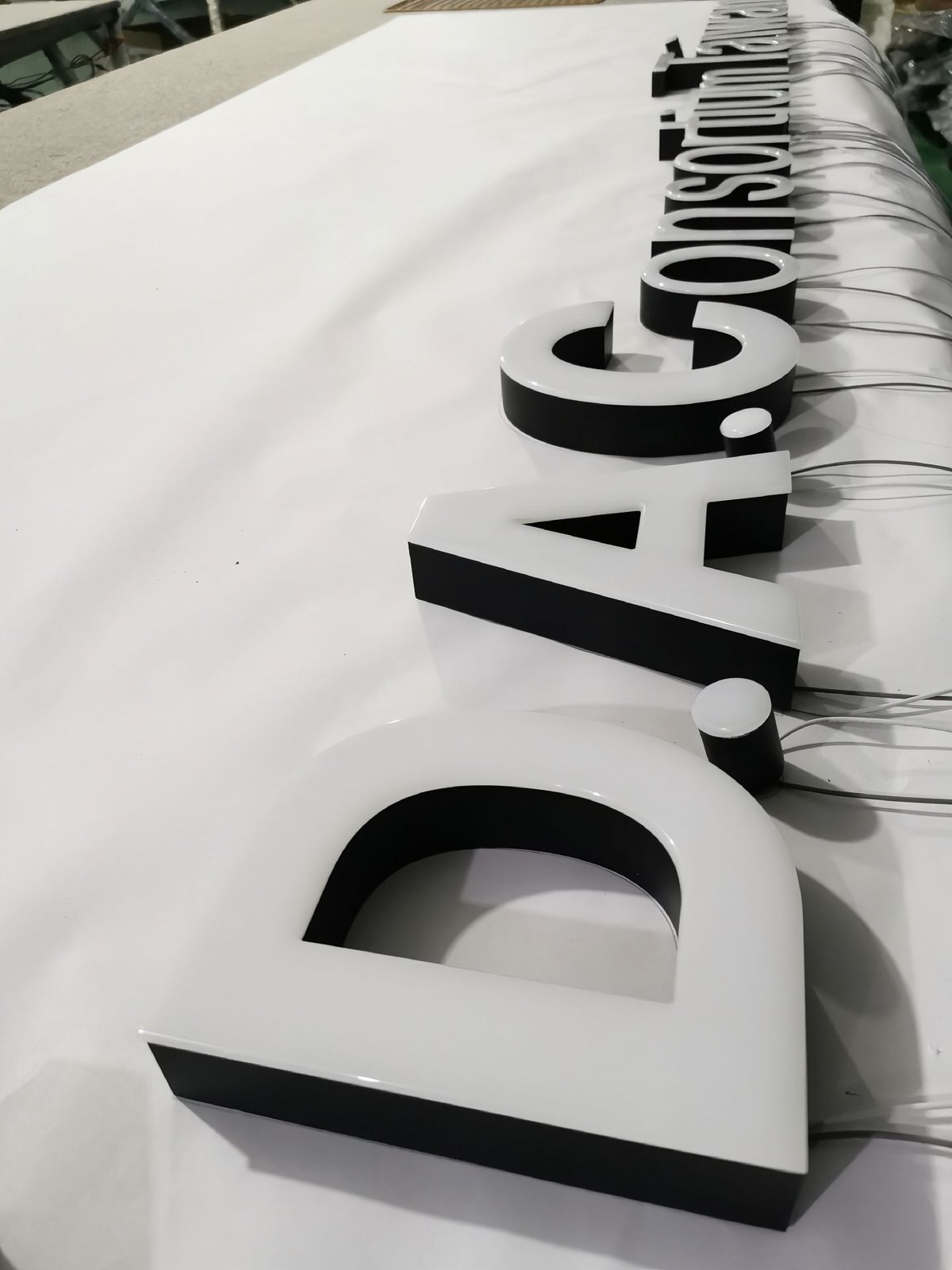
Thickness in 3D moulded letters changes both the visual weight of a letter and the way it is built. At 6 mm, the face reads as a relatively light dimensional element. A 10 mm face has more visible edge depth and a stronger sense of solidity without becoming heavy. At 15 mm, the side profile becomes more prominent and can create a clearer shadow when the sign is viewed from an angle. A 20 mm letter makes depth a major part of the design and may suit larger lettering or a facade where the side surface will be seen.
The published range is 30 mm to 1,200 mm letter height. Designs beyond that height use splicing or layering, and the layout must be reviewed before quotation. Bigger is not automatically better: a deep return can overwhelm a narrow wall, while a thin face may be difficult to clean if the counters are tight. Buyers should send dimensions in millimetres and a wall photo with an object for scale.
Thickness also affects installation. A deeper letter may need more room behind it for the chosen fixing, while a shallow face may call for a different mounting detail. The quotation should distinguish visible thickness from the hidden fixing depth so the installer can plan the wall connection correctly.
4. The four things that move the price of 3D moulded letters
The published price range for our custom 3D letter work is $650 to $1,800 USD, delivered DDP to a US address with duties included. That is a range, not a catalogue price. The first factor is size and copy: a short word is not equivalent to a long name with narrow counters, and every character adds cutting and material use. The second factor is material and thickness, because cast acrylic, extruded acrylic, brushed stainless, and aluminium are different inputs, and a 6 mm face is not the same construction as 20 mm.
The third factor is surface finish. A solid Pantone colour, mirror, brushed finish, cast crystal face, and film-facing each require different preparation and inspection. The fourth is the fixing arrangement. Threaded studs, keyhole plates, standoffs, and hidden rails are not interchangeable. The wall material, access behind it, and installation sequence determine which option is appropriate.
Quantity also affects the process comparison. Injection moulding spreads a large tooling cost across a long run. CNC routing uses a digital setup, which is better suited to custom sizes and changing quantities. Vacuum forming needs a forming tool but can be efficient for repeated shells. Comparing quotations without checking the production method and quantity can therefore produce a false saving. For the wider budget picture, see what a custom commercial sign costs.
5. Mounting, and why the 1:1 template matters
Mounting is designed before the letter reaches the wall. Threaded studs, keyhole plates, standoffs, and hidden rails each place the fixing points differently behind the face. The wall material matters too. Masonry, cladding, and framed internal walls do not offer the same fixing conditions, so the supplier needs to know what is behind the finished surface and how the installer can reach it. When that surface is a masonry monument base, see how 3D acrylic letters attach to monument signs.
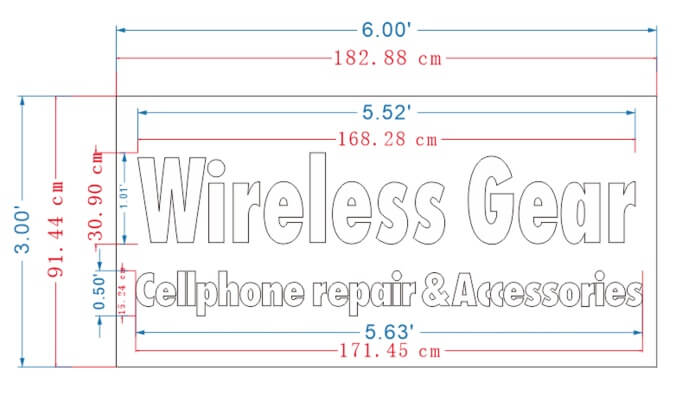
Every hole position is marked on a full-size 1:1 paper template. The installer can place the template directly on the wall, transfer the positions, and avoid rebuilding the full layout from a small drawing. This helps control the baseline, letter spacing, fixing height, and relationship to nearby doors or windows before drill holes are made.
The approved drawing and template should be kept together as the installation record. If a letter is later replaced or the sign is moved, the same fixing positions and finish references can be checked again. For a fuller explanation of fixing methods, read how commercial signs are mounted.
6. What to send us for an exact price
To quote 3D moulded letters, start with the wording or logo, finished letter height, quantity, and indoor or outdoor use. Send a straight-on wall photo and any drawing that shows available width, mounting height, and nearby doors, windows, or lighting. If the material, Pantone reference, or finish has already been chosen, identify it directly. If not, send a close-up reference and describe the intended effect.
Also state the preferred fixing method or the site constraint that affects it, and confirm that the 1:1 paper template is required. For a US delivery, include the destination postal code so the DDP delivery can be quoted correctly. Payment terms are 50% deposit, with the balance due after factory photos are provided. Standard production after sample approval is quoted at five working days, followed by DDP air transport of 12 to 20 days.
FAQ: Are 3D moulded letters always injection moulded?
No. “Moulded” is often a visual description. Injection moulding, vacuum forming, and CNC routing are different processes. Our letters are routed from sheet material and finished in the workshop.
FAQ: Can you make letters up to 1,200 mm high?
Yes. The published height range is 30 mm to 1,200 mm. Designs beyond that range use splicing or layering, and the layout must be reviewed before quotation.
FAQ: What materials and finishes are available?
The options include cast acrylic, extruded acrylic, brushed stainless, and aluminium. Finishes include solid Pantone colours, mirror, brushed, cast crystal, and film-facing.
FAQ: How are the letters fixed?
Depending on the design and wall, we can use threaded studs, keyhole plates, standoffs, or a hidden rail. Every hole position is marked on a full-size 1:1 paper template.
Send the size, copy, and wall photo
Tell us what you want the lettering to look like and where it will be installed. Include any artwork and the destination postal code if available.
Get a free 3D mockup