What Materials Are Used for Beer Cave Signs?
Beer cave signs are typically built from four materials: a powder-coated aluminum frame, a 3–5 mm cast acrylic or polycarbonate face, IP67-rated LED modules, and a Mean Well power supply. Below is the full breakdown of the beer cave signs materials we specify, and why a walk-in cooler — cold, wet and humid all year — destroys ordinary indoor signage within months.
Why a beer cave sign cannot use standard signage materials
A beer cave is not a normal retail wall. The sign surface runs at roughly 34–38°F, condensation forms every time the cooler door opens, and the door frame vibrates each time staff walk in and out. Standard indoor signage — thin PVC, paper, unsealed LED strip, or cheap vinyl — fails quickly here: acrylic fogs on the inside, LEDs corrode at the contacts, and vinyl lifts at the edges.
The materials below are the ones we actually specify for beer cave signs fabrication, based on real builds like our California c-store beer cave case study.
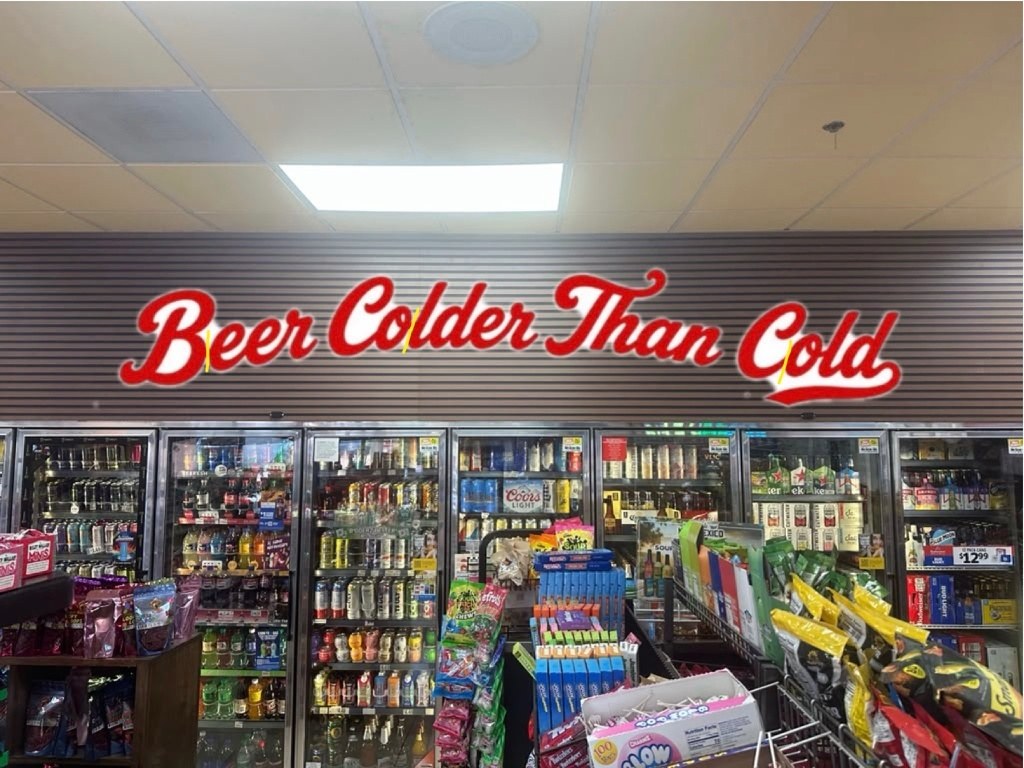
Beer Cave Signs Materials: The 6 Core Parts
1. Frame and backer: powder-coated aluminum or galvanized steel
The frame carries the weight and keeps the sign flat. Aluminum resists rust in constant humidity and stays light enough for door-mounted units; galvanized steel is used when a heavier backer is needed behind a large cooler wall. Both are powder-coated so the surface does not corrode or chip.
2. Face: 3–5 mm cast acrylic (or polycarbonate)
The face is what customers read. We use 3–5 mm cast acrylic rather than extruded acrylic, because cast acrylic resists yellowing, crazing, and cold-cracking far better — which matters at 35°F. For high-traffic or impact-prone spots, polycarbonate is the tougher alternative.
3. Lighting: IP67 LED modules, 5000K–6500K
IP67 means the LED module is sealed against dust and protected against temporary immersion. In a cooler, that sealing is exactly what stops internal corrosion. We wire modules in parallel so one failure does not black out the whole sign, and we usually specify 5000K–6500K for a clean, cold, high-contrast look. RGB modules are used when the brand wants color or animated effects.
4. Power: Mean Well industrial drivers
Cheap drivers fail on cold starts and voltage swings. We specify Mean Well power supplies with UL-recognized components, sized with headroom so the driver is never running at 100% load in a cold environment.
5. Moisture control: sealed channels, gaskets, and vent placement
Sealing the LEDs is only half the job. The wiring channel is sealed, gaskets sit behind the face, and vents are placed so condensation can drain instead of pooling inside. This is the difference between a sign that lasts years and one that fogs from the inside.
6. Mounting: vibration-resistant brackets and standoffs
Every door slam sends vibration into the sign. We use vibration-resistant brackets and standoffs sized to the actual door thickness, so the sign does not work loose over time.
Acrylic vs. vinyl for beer cave graphics
Vinyl stickers are the cheapest option and the first thing to fail: in cold and humidity the adhesive lifts and the edges peel. For anything permanent we print directly on acrylic or use a laminated face; for large fabric graphics we use a SEG fabric light box frame instead of sticking vinyl onto a cooler door.
Why IP rating matters more in a cooler than almost anywhere else
An IP rating has two digits: the first is dust protection, the second is water protection. IP67 (6 = dust-tight, 7 = protected against temporary immersion) is the practical minimum for a cooler interior. Non-rated LED strip usually works for a few months, then starts flickering or dropping modules as moisture reaches the circuit board.
How thick should the acrylic face be?
For most cooler-door signs, 3 mm cast acrylic is enough. We step up to 5 mm when the sign is large, spans more than about 40 inches, or sits somewhere it may be bumped. Thicker is not automatically better — an over-thick face adds weight that the door brackets then have to carry.
How we stop condensation inside a beer cave sign
Condensation is the real enemy in a cooler, not the cold itself. Warm air hits the cold sign face, moisture forms on the inside of the acrylic, and over time that moisture reaches the LEDs and the wiring. To stop it we seal the housing, use gaskets behind the face, place the vents so that any internal moisture can drain down and out instead of pooling, and keep the LED modules and driver on sealed connectors. On signs that face a hard temperature swing we also leave a small hidden air gap so the face can move slightly instead of cracking.
Do beer cave signs need a heater?
Most cooler-door signs do not need a heater — IP67 modules and sealed channels are enough. A heater is only added in extreme cases, such as a freezer door with heavy frost, where the glass or acrylic face would otherwise ice over. If your cooler runs below freezing at the sign surface, tell us during quoting and we will spec an anti-condensation heater and the extra driver capacity it needs.
How much do beer cave signs cost?
Price is driven more by beer cave signs materials than by size. A small single-sided cooler-door sign with printed acrylic and IP67 modules sits at the low end; a large double-sided RGB beer cave sign with a full aluminum frame, sealed channels, and Mean Well drivers sits at the high end. Because everything ships DDP to the USA, the quoted price already includes freight, duties, and final delivery — there is no second invoice on arrival. Send your cooler dimensions and logo for an exact number.
FAQ: beer cave sign materials
Are beer cave signs waterproof?
The LEDs and power supply are IP67-rated and the frame is sealed, so the sign is built for a wet, condensing environment. It is not designed to be submerged, but it handles the humidity and condensation of a working cooler.
Can I use regular acrylic for a beer cave sign?
Use cast acrylic, not cheap extruded acrylic. Extruded acrylic is more likely to craze and crack in the cold, which is why we specify cast acrylic for cooler work.
What LED color is best for a beer cave sign?
5000K–6500K white gives the cleanest, coldest look and the best contrast. RGB modules are the choice when you want brand colors or animated effects.
How are beer cave signs mounted?
Most cooler-door signs use standoffs or brackets sized to the door thickness, with the frame sealed against the surface. Wall-mounted cooler signs use bracket systems engineered to keep large panels flat.
Related reading
- Beer cave signs fabrication — product and specs
- California c-store beer cave case study
- Channel letters vs light box: which to choose
Need a beer cave sign quote?
Send your cooler dimensions, logo, and store ZIP code. We return a free 3D mockup and a DDP quote within 24 hours.
Chat on WhatsApp →